


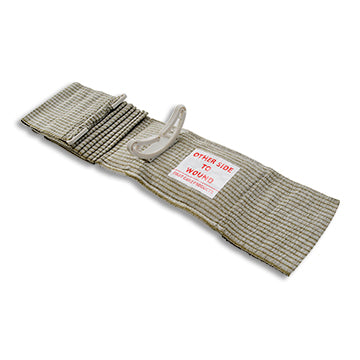
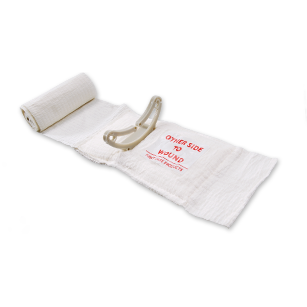


Emergency Bandage (Israeli Bandage)
- Australian veteran owned since 2010
- Free AU shipping over $250
- 99% orders shipped within 24 hours
- In stock, ready to ship
- Backordered, shipping soon
The Emergency Bandage — widely known as the Israeli Bandage or Israeli pressure dressing — is the benchmark haemorrhage control dressing used by military, paramedics, and emergency responders globally. Combining a sterile non-adherent pad, elastic bandage, and integrated pressure applicator in a single sterile package, it delivers fast, focused compression over a wound and holds it there.
The bandage takes its common name from its development by the Israeli Defence Forces medical corps in the 1990s. It was designed to be applied rapidly under combat conditions — by a single person, on themselves or a casualty, without specialist equipment. That design principle is what makes it useful beyond the military: it works in any situation where you need to apply and maintain direct pressure to a serious wound.
Unlike basic wound dressings available at chemists, the Emergency Bandage is a clinical-grade haemorrhage control device. It is used in trauma kits, IFAKs, vehicle emergency setups, and as part of bleeding control configurations for worksites, remote operations, and emergency services. TacMed stocks TGA-compliant Emergency Bandages — not consumer alternatives.
Emergency Bandage vs OLAES Modular Trauma Dressing
| Feature | Emergency Bandage (Israeli Bandage) | OLAES Modular Trauma Dressing |
|---|---|---|
| Primary function | Focused wound compression and pressure | Compression plus wound packing capability |
| Pressure applicator | Integrated pressure bar | Removable pressure cup |
| Wound packing | No | Yes — includes packing gauze |
| Application | Simple, fast, low-profile | More modular, multi-step |
| Best for | Speed, simplicity, compact carry | Versatility, deeper wound management |
| Common use | IFAKs, vehicle kits, rapid-response kits | Trauma kits, extended care, training |
The Emergency Bandage is the faster, simpler option — ideal when speed of application is the priority and the wound is accessible for direct pressure. The OLAES provides more capability for complex or deep wounds where packing gauze is required. Many trauma kits carry both: the Emergency Bandage for fast surface application, the OLAES for wounds that need packing. See the OLAES Modular Trauma Dressing if you need that additional capability.
- Integrated pressure applicator: Built-in pressure bar delivers focused compression directly over the wound — more effective than improvised pressure dressings.
- Broad wound coverage: Suitable for limb, torso, head, neck, and groin wounds — locations where a tourniquet cannot be used.
- Fast single-person application: Can be applied to yourself or a casualty rapidly, even under stress or with limited dexterity.
- Sterile and vacuum-sealed: Long shelf life, compact carry — fits IFAKs, trauma kits, vehicle kits, and duty belt setups.
- Clinical-grade haemorrhage control: TGA-compliant. Used by military, paramedics, and emergency services globally — not a retail first aid dressing.
- Closure system included: Hook-and-loop closure secures the bandage in place during casualty movement and evacuation.
What is an Israeli Bandage?
The Israeli Bandage is the common name for the Emergency Bandage — a clinical-grade pressure dressing developed for rapid haemorrhage control in trauma and combat situations. It combines a sterile non-adherent pad, elastic bandage, and integrated pressure applicator in a single package. It is designed to apply and maintain direct pressure over a serious wound without requiring additional equipment or a second pair of hands.
Why is it called an Israeli Bandage?
The Emergency Bandage was developed in the 1990s by Bernard Bar-Natan, an Israeli military medic, for use by the Israeli Defence Forces. Its design addressed a practical problem: soldiers needed a dressing they could apply to themselves with one hand, rapidly, under stress. The "Israeli Bandage" name became widely used internationally as the product was adopted by military and emergency services around the world. Its formal product name is the Emergency Bandage.
How do you use an Israeli Bandage?
Basic application steps for limb wounds:
- Open the sterile packaging and locate the non-adherent pad (the white absorbent pad).
- Place the pad directly over the wound with firm pressure.
- Wrap the elastic bandage around the limb, passing it through the pressure applicator bar.
- Pull the bandage back over the bar to create a lever effect — this applies focused compression directly over the wound.
- Continue wrapping the bandage around the limb to secure the dressing.
- Secure with the hook-and-loop closure. Do not cover the pressure bar.
- Seek urgent medical care immediately.
For torso, head, neck, or groin wounds, application technique varies. Follow your training and local protocols. If you haven't trained with this dressing, see our training courses or training equipment.
Israeli Bandage vs tourniquet — which should I use?
They serve different purposes and are both essential in a complete trauma kit:
- Use a tourniquet for severe arterial bleeding from an arm or leg. A tourniquet applied high and tight on the limb stops blood flow entirely and is the fastest intervention for life-threatening limb haemorrhage.
- Use an Israeli Bandage for wounds on the torso, head, neck, groin, or axilla — where a tourniquet cannot be applied — or for wounds where direct pressure is the appropriate response.
In a full trauma kit, you carry both. The tourniquet addresses limb bleeds; the Emergency Bandage addresses everything else. See our tourniquet collection or bleeding control kits for complete setups.
What is the difference between an Israeli Bandage and a regular pressure dressing?
A standard pressure dressing applies general compression across a wound. The Emergency Bandage's integrated pressure bar creates a focal point of direct compression — the mechanical advantage of the bar concentrates force exactly where it is needed. This makes it significantly more effective for controlling haemorrhage than bandaging over a standard gauze pad.
Can I buy an Israeli Bandage at a chemist?
Some chemists stock basic wound dressings, but the clinical-grade Emergency Bandage — with its integrated pressure applicator and haemorrhage control design — is a specialist trauma supply, not a retail first aid item. TacMed stocks TGA-compliant Emergency Bandages selected for trauma use, not the consumer alternatives found in standard first aid sections.
What sizes does the Emergency Bandage come in?
The Emergency Bandage is available in multiple sizes — most commonly 4-inch and 6-inch widths. The 4-inch is suitable for limb wounds and compact carry in IFAKs. The 6-inch provides broader coverage for larger wounds, torso injuries, and head dressings. Check the product variants above for available sizes.
Israeli Bandage vs OLAES — which is better?
Neither is universally better — they serve different use cases. The Emergency Bandage is faster and simpler: it applies direct pressure in a single step and is ideal for compact carry and rapid application. The OLAES Modular Trauma Dressing adds wound packing capability through a removable pressure cup and included packing gauze — making it more versatile for deep or complex wounds. If your kit needs to handle both surface and deep wound management, consider carrying both. See the OLAES product page for a full comparison.
Does the Emergency Bandage expire?
Yes. Like all sterile medical products, the Emergency Bandage has an expiry date printed on the packaging. Inspect your kit regularly and replace any dressings approaching or past their expiry. Sterility cannot be guaranteed after the expiry date.
How many should I carry in my kit?
Most trauma kit configurations include at least one Emergency Bandage as a minimum. Professionals carrying full kits often include two — one for immediate application and a second for wound reassessment or a second casualty. If you are building a complete bleeding control kit, see our bleeding control collection for pre-configured options.
📦 Shipping Overview
- Flat rate: $12.95 Australia-wide
- Free shipping: Orders over $250
- Dispatch time: 1–2 business days (Mon–Fri)
🚚 Delivery Estimates
- Metro areas: 3–7 business days
- WA & NT: Up to 10 business days
- During peak or promo periods: Please allow additional time
📍 Delivery Instructions
Please provide a delivery address where someone is available during business hours. PO Boxes are accepted. If unattended, your order may be left in a secure location or taken to the nearest post office or depot.